Should Investors Be Taking More Risk Right Now?
By Todd Stankiewicz | CIO, SYKON Capital | Portfolio Manager, Free Markets ETF (FMKT)
Markets Can Rise and Still Offer a Poorer Risk-Reward Setup
That does not mean stocks cannot continue higher. They can. But investing is not only about direction. It is also about probability, price, and whether investors are being paid enough for the risks they are taking.
That is why the current environment deserves a closer look. Some disciplined capital allocators are showing patience. Jamie Dimon recently said he would not be a buyer of equities or long-dated U.S. Treasurys at current prices, and Berkshire Hathaway has continued to build a large cash position while remaining a net seller of stocks.
At the same time, broad investor stock allocations remain elevated. That contrast is important. It does not mean every investor should copy Berkshire Hathaway or Jamie Dimon. It does suggest investors should ask whether they are adding risk because their plan requires it, or because the market has made risk feel easier to own.
Valuations Are High, Which Can Lower the Margin for Error
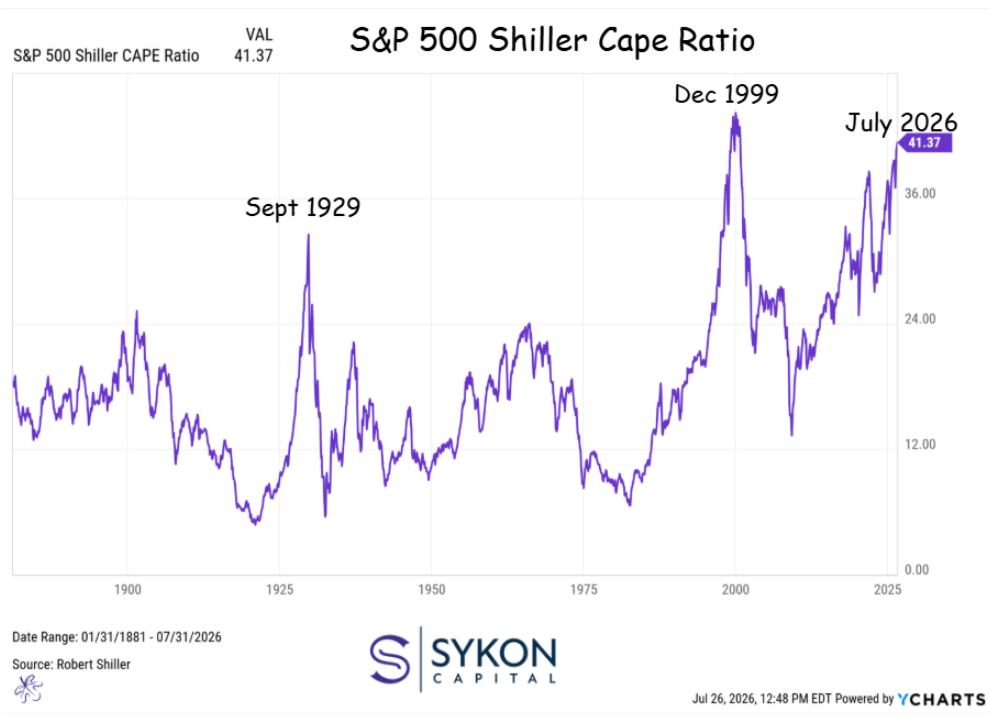
Shiller CAPE remains near historically elevated levels, suggesting valuations are leaving less room for disappointment.
The Shiller CAPE ratio is near historically elevated levels, around 41 times earnings. Valuation is not a short-term market timing tool, but it can shape future return probabilities. When investors pay more for a stream of earnings, more needs to go right for those returns to be justified.
High valuations make expectations more important. Earnings need to hold up. Growth needs to remain strong. Interest rates need to avoid creating too much pressure. When the bar is high, even a modest disappointment can matter.
Investor Stock Allocations Look Extended
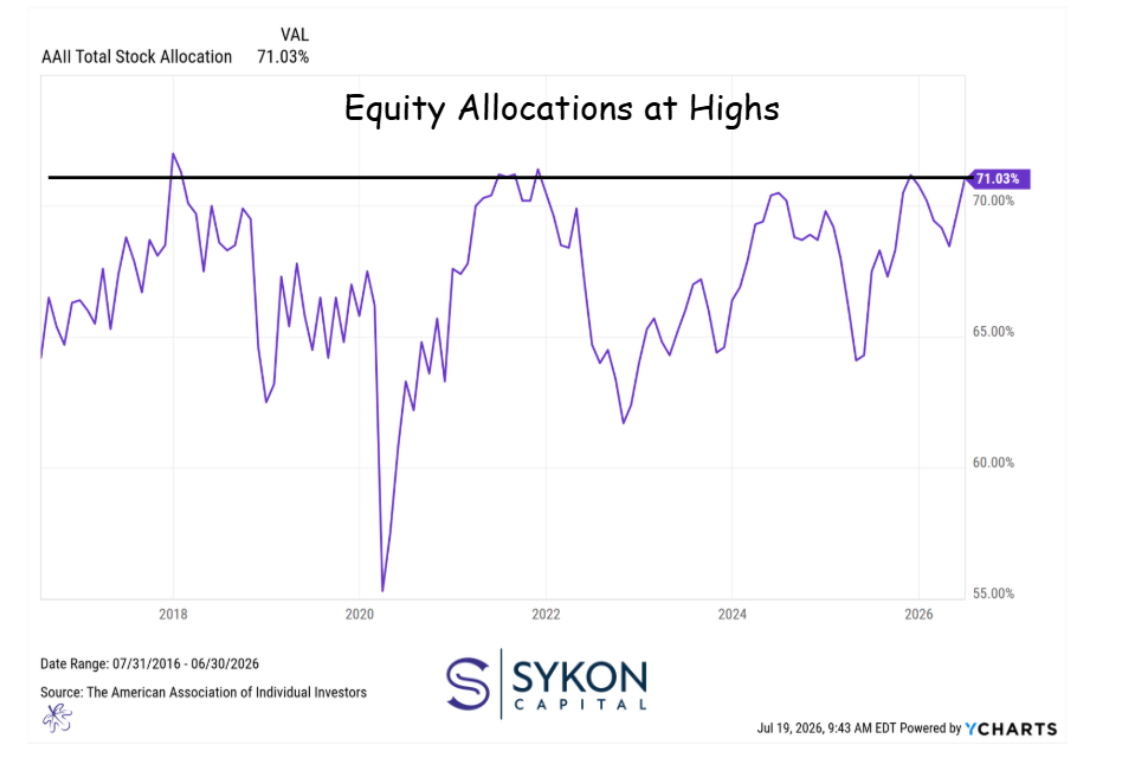
Investor stock allocations remain elevated, which may reflect performance chasing or portfolio drift after a strong market run.
The AAII Asset Allocation Survey recently showed stock allocations near 71%, with bonds around 14% and cash around 15%. Elevated equity exposure can suggest that investors are leaning heavily into what has already worked.
This can happen in two ways. Some investors actively chase performance. Others simply let their stock exposure drift higher as the market rises. Either way, the result can be the same: a portfolio that carries more equity risk than the investor originally intended.
Credit Spreads Are Tight, Which Limits Compensation for Credit Risk
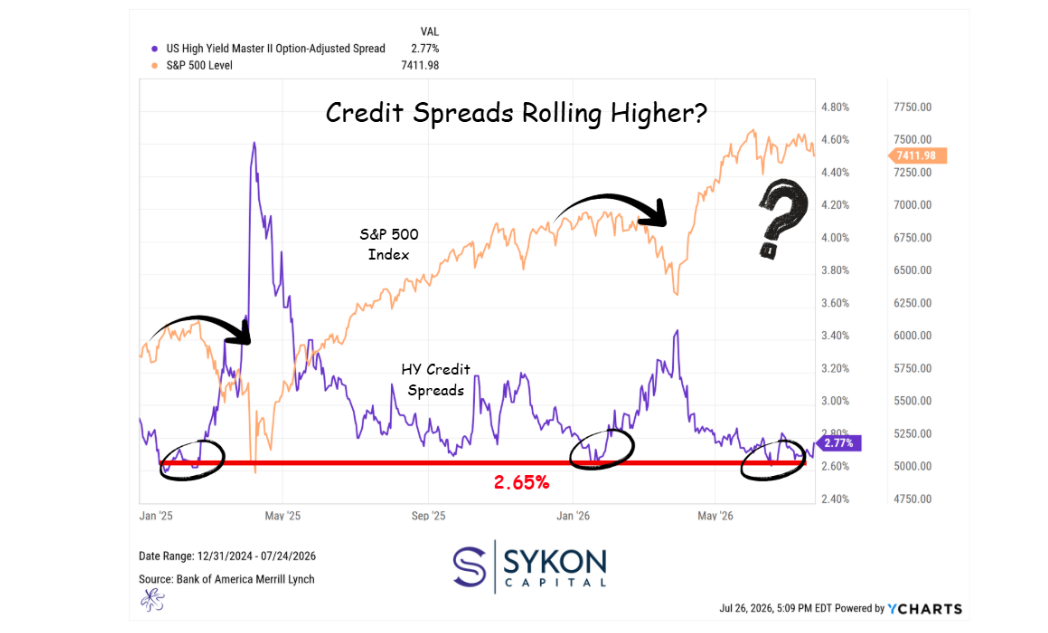
Tight high-yield spreads suggest investors are not being paid much extra for taking credit risk.
High-yield credit spreads remain tight. The ICE BofA US High Yield Index Option-Adjusted Spread was 277 basis points as of July 23, 2026. Tight spreads mean investors are not receiving much additional compensation for owning lower quality credit.
That matters because credit spreads move in cycles. They compress when investors feel confident, and they can widen when risk appetite changes. If spreads widen, high-yield bonds can decline in price. Private credit may also face pressure because it is exposed to many of the same underlying credit risks, even though it is not priced the same way public high-yield bonds are.
Lower Quality Credit May Already Be Repricing Risk
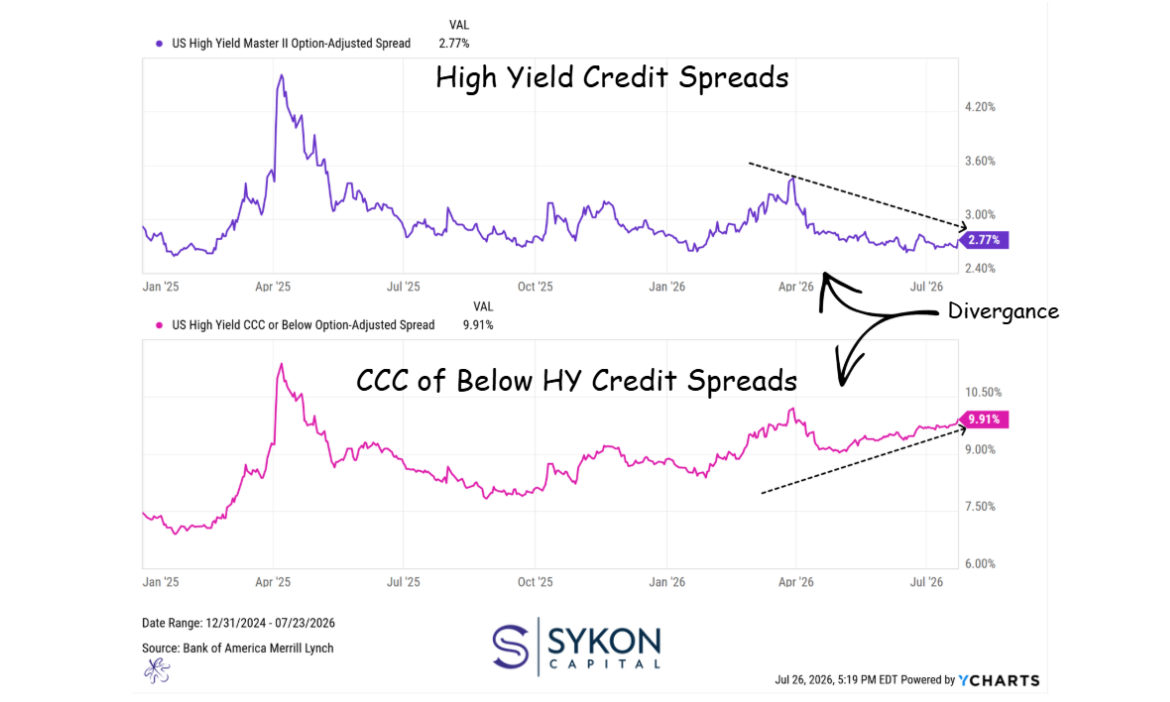
CCC spreads have started to rise, which may signal that lower quality credit is beginning to reprice risk first.
CCC-rated credit spreads have been rising beneath the surface. This is important because lower quality credit often reacts first when investors become more selective about risk.
If risk begins to reprice in the weakest credits first, investors should be careful about assuming that broader credit markets are insulated. The same logic can apply to lower quality stocks, highly speculative investments, and income strategies that rely heavily on credit conditions staying favorable.
Technology Leadership and Seasonality Add More Context
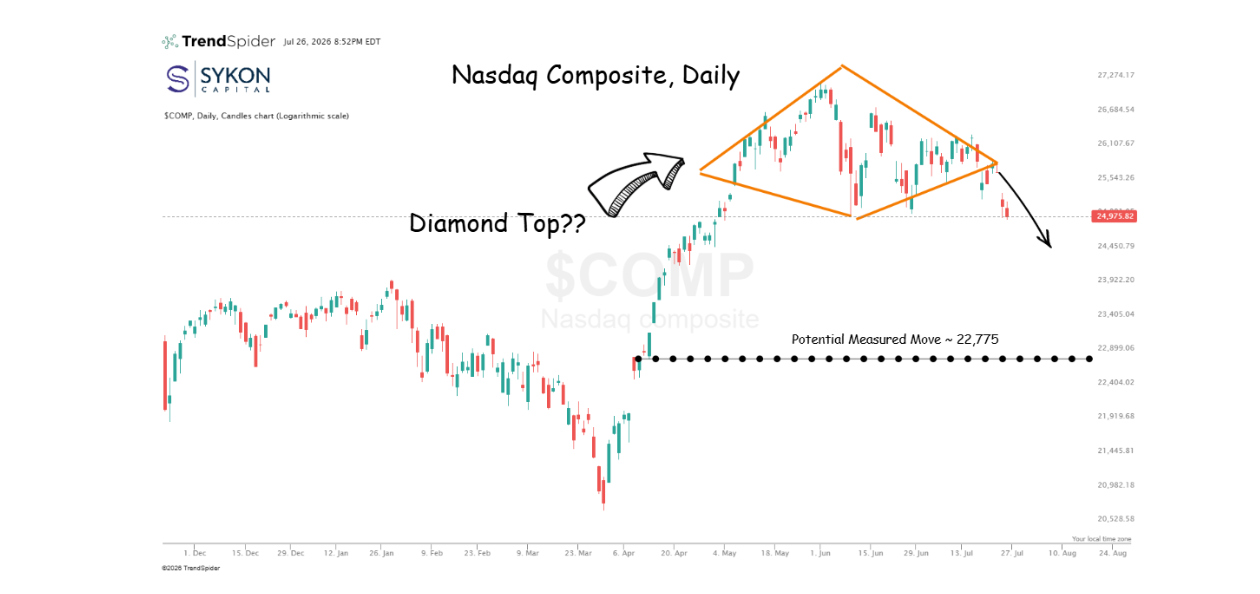
A potential diamond top in the Nasdaq would add to the broader message that market leadership may be losing momentum.
The Nasdaq and technology leadership remain important to watch because they have carried a meaningful portion of the market’s recent gains. If leadership begins to narrow or weaken, the broader market may become more fragile than it appears.
Seasonality is another factor. July has historically been one of the stronger months for stocks, but August, September, and October have often been more difficult. Seasonality does not determine market direction, but it can add context when other risk signals are already present.
How Investors Can Think About Portfolio Risk Now
The main decision is not whether to be fully in or fully out of the market. For most investors, that is the wrong framework. A better starting point is whether the current allocation still matches the purpose of the money.If a portfolio has drifted higher in equity exposure, rebalancing may bring the risk level back in line with the plan. If an investor holds concentrated stock positions, trimming or diversifying may reduce exposure to a single outcome. If a portfolio relies heavily on high-yield bonds or private credit, moving up in credit quality may reduce sensitivity to spread widening.
None of this requires panic. It requires discipline. A portfolio should be able to adapt as conditions change, but adaptation is not the same thing as chasing what has already worked.
Conclusion: Ask Whether the Risk Still Fits the Plan
The current market setup does not require investors to predict the next move. It does require them to ask better questions. Are valuations leaving enough room for error? Are credit investors being paid enough for the risks they are taking? Has equity exposure drifted beyond the intended allocation? Is the portfolio still built around the return the investor actually needs?A strong market can make risk feel easier to own. That is why investors should revisit the plan before the market tests it.
Frequently Asked Questions
Should investors take more risk when the market is near all-time highs?Not automatically. A market near highs can continue higher, but investors should first ask whether adding risk is required by their plan. If the portfolio already has enough risk to pursue the investor’s goals, chasing more exposure may not be necessary.
What does a high Shiller CAPE ratio mean for investors?
A high Shiller CAPE ratio means investors are paying a high price relative to long-term earnings. It does not predict short-term market direction, but it can suggest lower future return potential or a smaller margin for disappointment.
Why do tight credit spreads matter?
Tight credit spreads mean investors are receiving less extra yield for taking credit risk. If spreads widen, high-yield bonds and other credit-sensitive investments can decline in value.
How can private credit be affected by widening credit spreads?
Private credit is not priced the same way as public high-yield bonds, but it can still be exposed to similar borrower and credit risks. If spreads widen and liquidity tightens, private credit investments may face pressure even if the pricing adjusts more slowly.
What does it mean if investor equity allocations are elevated?
Elevated equity allocations may suggest that investors are leaning heavily into stocks. This can happen because investors are actively chasing recent performance or because they have allowed their stock allocation to drift higher without rebalancing.
What should investors do if their portfolio has drifted from its target allocation?
Investors should review whether the current allocation still matches their goals, time horizon, and risk tolerance. If stock exposure has drifted too high, rebalancing can help bring the portfolio back in line with the original plan.
About the Author
Todd Stankiewicz | Chief Investment Officer, SYKON Capital
Todd Stankiewicz is the Chief Investment Officer of SYKON Capital, a fee-only registered investment advisor with offices in Westchester County, NY and Jupiter, FL. He is a recurring guest on Fox Business and the Schwab Network, where he discusses markets, portfolio strategy, and investor behavior.
Learn more at www.sykoncapital.com
Advisory services are offered through SYKON Capital LLC, a registered investment advisor with the U.S. Securities and Exchange Commission. This material is intended for informational purposes only. It should not be construed as legal or tax advice and is not intended to replace the advice of a qualified attorney or tax advisor. The information contained in this presentation has been compiled from third-party sources and is believed to be reliable as of the date of this report. Past performance is not indicative of future returns, and diversification neither assures a profit nor guarantees against loss in a declining market. Investments involve risk and are not guaranteed.