The Iran Headlines Are Loud. My Charts Are Calm.
By Todd Stankiewicz | CIO, SYKON Capital | Portfolio Manager, Free Markets ETF (FMKT)
Turn on the television right now and it feels like the world is ending.
Drones. Footage of strikes on Tehran. The Strait of Hormuz closed.
The VIX spiking to levels not seen in three months. Breathless anchors asking whether this is the beginning of something much worse.
I get it. It is scary to watch. And if you are a client or an investor sitting at home refreshing your portfolio, the temptation to do something, anything, is real.
But this is exactly the moment where discipline matters.
Because right now I am not watching the news. I am watching the charts.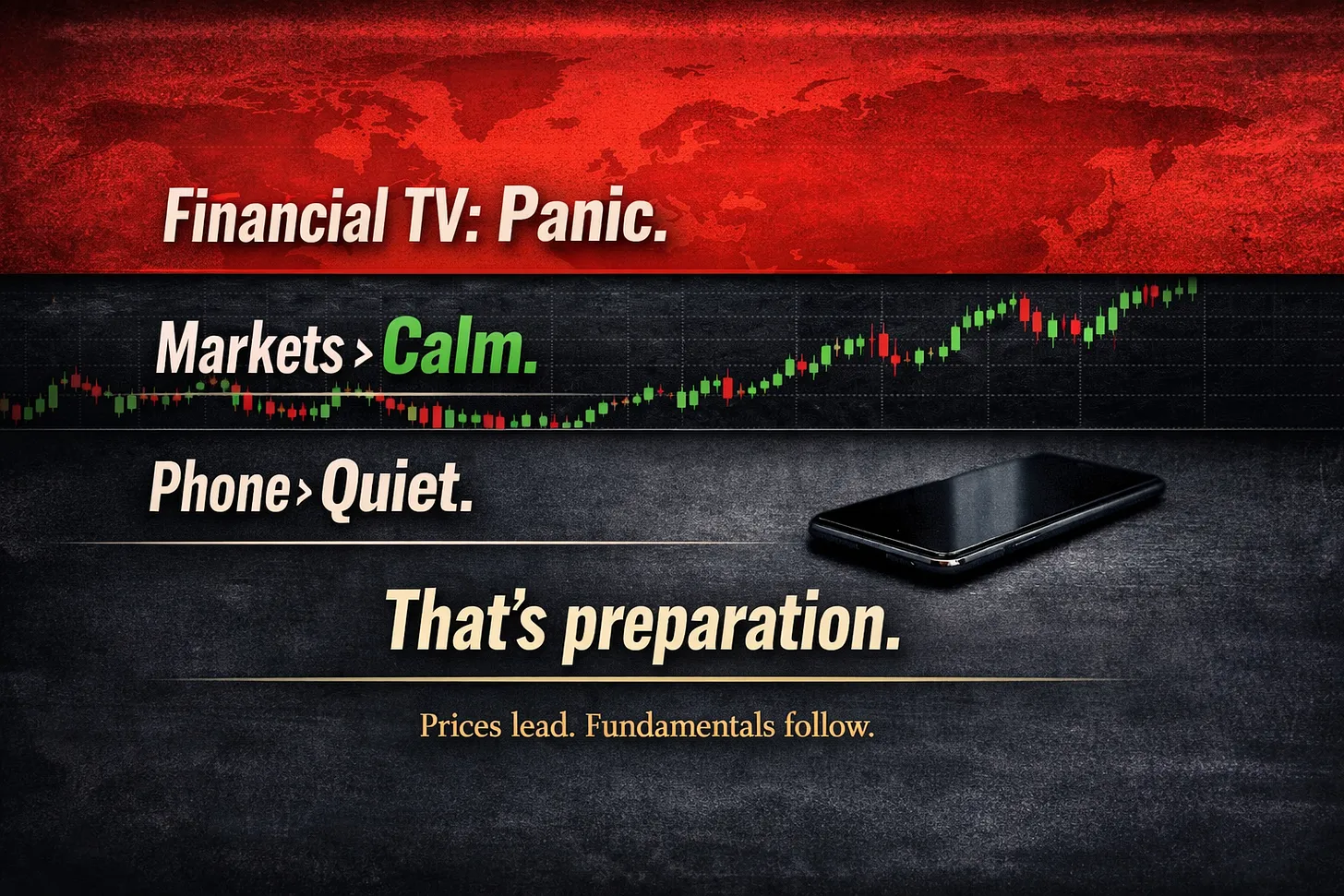
Prices Lead. Fundamentals Follow.
That is not a dismissal of what is happening in the Middle East. The conflict is serious. The human cost is real. But my job is not to be a geopolitical analyst. My job is to help clients protect and grow their wealth. And to do that well, I have to stay disciplined about where I get my signals.My mantra is simple: prices lead, and fundamentals follow.
What that means in practice is that the market tends to price in information before the headlines catch up. So rather than reacting to what I read, I focus on what the price action is actually telling me.
This week, here is what the charts are saying: so far, this is a blip.
The S&P 500 has been in a sideways pattern since roughly October and November of 2025. Monday opened sharply lower. By Tuesday’s close, the index was down less than 1%. On a weekly chart, that kind of intraday swing barely registers as a meaningful move. We have not broken below the 200-day moving average. We have not breached the lower Bollinger Band (a technical measure of price volatility that can signal a trend shift). The 40-week moving average on the weekly chart is still intact.
Those are the levels I watch. Until they break, the noise is just noise.
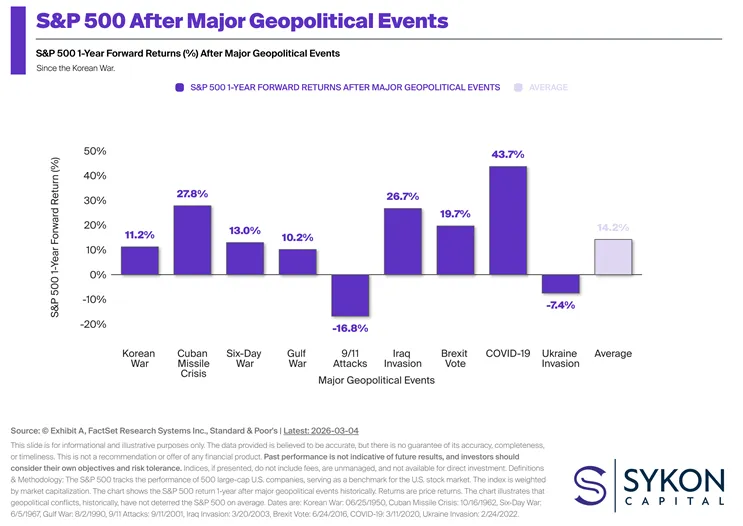
There is also some useful historical context worth putting on the table. We looked at how the S&P 500 has performed in the one year following nine major geopolitical crises, from the Korean War to COVID-19 to the Ukraine invasion. The average 1-year forward return across all nine events was +14.2%. Seven out of nine produced positive returns. Only two, the 9/11 attacks and the Russia-Ukraine invasion, resulted in negative 1-year forward returns. That is not a reason to be complacent. But it is a reminder that, historically, the market has tended to price through geopolitical shocks over time. And that is exactly what disciplined, data-driven investors expect it to do.
The Real Work Happens Before the Event
Here is something I want to be clear about, because I think it gets misunderstood.This is not a “sit tight and ride it out” post. That is not how I manage money. That is now how we at SYKON manage money. We do not believe in passive buy-and-hold as a complete strategy, and I am not asking anyone to just close their eyes and hope for the best.
What I am saying is something different. The preparation for moments like this one happens long before the missiles start flying.
Before any of this, I work with each client to understand three things: What is your target rate of return? What do you actually need to earn to achieve your goals? And what level of risk do you need to take to get there?
Those questions matter more than most people realize. Not every client needs to match the S&P 500. In fact, chasing the index typically means taking on more risk and more volatility than many people actually need or can stomach. When you know your number, you can build a portfolio around that number. And when you build a portfolio around that number, you are not scrambling when the VIX spikes.
Win by Not Losing
At the core of how I think about risk management is a simple idea: the biggest risk to a portfolio is a large drawdown.Think about it mathematically. If you lose 30%, you need to gain roughly 43% just to get back to where you started. If you lose 50%, you need a 100% gain to recover. Large losses do not just hurt in the moment. They set you back in ways that take years to undo.
So, the goal is to win by not losing. Avoid the big drawdowns. Stay focused on the things that are working. Let the upside take care of itself over time.
In practice, that means I am watching signals beyond just the major indices. I look at things like the ratio of Treasury bonds to high-yield bonds. When defensive assets start to outperform riskier ones, that is often an early signal that something is shifting under the surface.
In recent weeks, those signals were nudging slightly more defensive, so we made modest adjustments in client portfolios to reduce equity allocations. Nothing dramatic, because the overall trend was still positive. But the discipline was there.
But we do not rely on a single signal.
We evaluate momentum in two ways. Time series momentum looks at whether an asset is trending higher or lower over time. Relative momentum looks across the market to see which sectors and asset classes are gaining leadership and which ones are beginning to roll over.
We also pay close attention to how the broader indices and individual sectors are behaving relative to key technical reference points. Are markets trading above or below their 200 day moving averages? Are prices pushing outside of their Bollinger Bands, suggesting volatility is expanding or trends may be shifting?
When several of these signals begin pointing in the same direction, they often provide a much clearer picture of whether risk in the system is rising or falling.
Right now, the broader indices and many sectors are still trending positive.
That is active risk management. Not panic. Not paralysis. Measured, rules-based adjustments based on what the data is showing.
We Don’t Know What the Next Risk Event Will Be. That’s the Point.
I did not know this Iran conflict was coming. Nobody did. And that is exactly why we do not build a risk management process around predicting specific events.Maybe this escalates further. Maybe it does not. Maybe the next big risk is not Iran at all. Maybe it is contagion spreading through private credit markets, where a lot of capital has been deployed into illiquid structures that have not yet been stress-tested. Maybe it is the AI trade, which has driven enormous gains but carries its own concentration risk. Maybe it is something none of us are even talking about right now.
I do not know. And I would be skeptical of anyone who claims they do.
What I do know is this: if something is genuinely breaking down in the markets, the charts will tell me. Prices lead. The data will show up before the headlines explain it. And when it does, I will act.
What We Do at SYKON Capital
Clients who work with us have been fortunate. Since the financial crisis, markets have been remarkably strong. Portfolios have grown. We are sitting near all-time highs. That is a good thing. But it is also exactly the moment when discipline matters most, because there is more to protect.At SYKON Capital, we build custom portfolios using ETFs and individual securities. We prioritize liquidity, because we believe you should be able to access your money and adjust your positioning when conditions change. We do not typically position clients in illiquid alternatives that can look stable on paper but are difficult to exit when you actually need to.
Most importantly, we manage risk actively. We are not a set-it-and-forget-it shop. We watch the charts. We monitor the signals. We make adjustments when the data calls for it, and we hold steady when the noise is just noise.
This week, the Iran headlines are loud. The fear is real. But when I look at my charts, the data is telling me to stay disciplined, not to react. When the data tells us to adjust, we will.
That is what we do. And if you are wondering whether your portfolio is positioned the right way for whatever comes next, that is a conversation worth having.
Advisory Services offered through SYKON Capital LLC, a registered investment advisor with the U.S. Securities and Exchange Commission. This material is intended for informational purposes only. It should not be construed as legal or tax advice and is not intended to replace the advice of a qualified attorney or tax advisor. The information contained in this presentation has been compiled from third party sources and is believed to be reliable as of the date of this report. Past performance is not indicative of future returns and diversification neither assures a profit nor guarantees against loss in a declining market. Investments involve risk and are not guaranteed.